






Robert Tannen's Vision of Jackson Square as a Civic Monument
The artist's abstract sculpture honors a great American plaza.
By Molly Reid Cleaver, senior editor
May 27, 2022
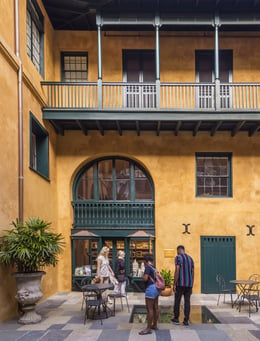
This summer and fall, visitors to HNOC’s Tricentennial Wing can see New Orleans’s famed Jackson Square without ever leaving the building.
A new installation in the third-floor Laura Simon Nelson Gallery features Jackson Square, a multicomponent sculpture by New Orleans artist and urban planner Robert Tannen. The artwork comprises abstract representations of all the structures surrounding the square—the Pontalba buildings, Cabildo, Presbytère, and St. Louis Cathedral—as well as the riverfront levee and the square’s statue of Andrew Jackson.

Tannen originally created the sculpture in 1982 as a commission for Pan-American Life Insurance Co., two years after the opening of the Pan-American Life Center at 601 Poydras Street. “They commissioned a number of works primarily by Louisiana artists,” Tannen said. Made of aluminum and weathering steel and fabricated from Tannen’s design by the French Quarter–based firm Holzer Sheet Metal Works, Jackson Square sat in a large public space on the building’s 11th floor, near its cafeteria and dining area.
“The idea was to create a three-dimensional model of Jackson Square, which I have always believed is one of the great urban spaces of the world—not just the United States, but the world—and including the levee, the surrounding landscape,” said Tannen. “I’ve always enjoyed going there and having a muffuletta sandwich ever since I moved to New Orleans 50-plus years ago.”

Tannen, who was born in Brooklyn and worked with the architect and futurist R. Buckminster Fuller in the 1960s, first came to the Gulf Coast to assist in planning-related recovery efforts following 1969’s Hurricane Camille. After circulating in the Experimental-architecture and post-avant-garde scenes in the Northeast, he moved to New Orleans permanently in the 1970s. An artist of many media, Tannen frequently uses architectural forms and principles to address concepts related to Louisiana’s built and natural environments.
At the time of his Pan-American Life commission, “I was focused on making shotguns [houses] and other local forms and abstracting the forms, eliminating the windows, doors, filigree, et cetera. So they were basic sculptural forms, almost geometric forms,” he said.

The entire sculpture has a footprint of about 10-by-12 feet, and the tallest structure, St. Louis Cathedral, stands 5 feet tall. The long levee form serves as a representative and literal retaining wall, forming the fourth side of the titular square and reminding the viewer of the city’s deeply embedded relationship with the river and with water. While the piece is meant to honor the existing layout and design of the square, the statue of Andrew Jackson—a pigeon on his head—is an anomaly: “I’d always been aware of Jackson’s role in the Trail of Tears, so the sculpture as it was done would allow that piece to be moved or removed—just as we are now removing monuments of such controversy,” Tannen said.
Rounding out the installation is a text panel with a QR code linking to more information about the history of Jackson Square and its urban development over time.
“I think of the sculpture as giving appropriate importance to that urban space,” Tannen said. “By abstracting the buildings, it’s a way to convey to someone looking at the space and understanding it as a special urban experience.”
Robert Tannen’s “Jackson Square”
Artist and urban planner Robert Tannen’s homage to a great American plaza

Related Stories

John Clemmer’s Circle of Louisiana Modernists
Author John Ed Bradley recalls his time with Clemmer, who opened a door into the world of 20th-century New Orleans art.

Salazar’s Surprises
Explore interesting connections hidden in the artist’s portraits of colonial elites.
Related Collection Highlights

Burning Orchid Nightclub
This large-scale oil painting celebrates New Orleans nightlife in a bar scene teeming with 100 local notables.


Homage to the French Quarter
The bohemian scene of midcentury New Orleans comes to life in this exciting acquisition.
Related Virtual Exhibitions

French Quarter Life: People and Places in the Vieux Carré
Artistic impressions of New Orleans’s most iconic neighborhood

From Cameo to Close-Up: Louisiana in Film
Explore how the picturesque scenery of Louisiana has provided the backdrop for films since the early 1900s.
Related Books
Bunny Matthews: His Life, Art, and Obsessions
by Alison Fensterstock and Michael Tisserand


Complementary Visions of Louisiana Art
with essays by William H. Gerdts, George E. Jordan, and Judith H. Bonner
Subscribe to Our Newsletter
