





Tennessee Williams
A guide to HNOC’s Tennessee Williams holdings
View our guide to HNOC’s extensive holdings about the famous playwright, including a summary of previously unpublished works found in the Tennessee Williams Annual Review.
HNOC is one of four main repositories that steward the playwright’s archive. This is a guide to HNOC’s Williams holdings, as well as a summary of previously unpublished works found in the Tennessee Williams Annual Review.
Introduction
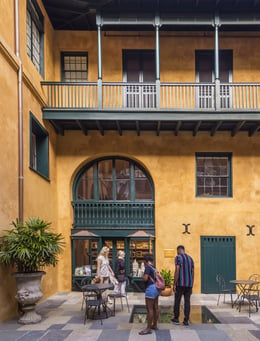
In 1939 Tennessee Williams was living in an attic apartment at 722 Toulouse Street in the French Quarter, in what he called the “poetic evocation of all the cheap rooming houses of the world” (Vieux Carré 4). HNOC founders Kemper and Leila Williams (no relation to Tennessee) had recently purchased and were renovating the circa 1794 property just around the corner at 533 Royal Street, which backed into the 722 Toulouse domain. In 1945, the Williamses purchased the “poetic evocation” and appropriately dubbed it the “garage apartment.” Little did they know at the time that among its former tenants was someone who would become one of the most notable literary figures in the world, and that his legacy, and their own, would one day be intertwined.
In the mid-1990s, HNOC began actively collecting materials related to Tennessee Williams and his legacy. With the acquisition of the Fred W. Todd Tennessee Williams Collection in 2001, the institution became one of the major repositories for Tennessee Williams materials. The collection was the lifelong labor of love for collector Fred W. Todd. Over the course of 45 years, Todd amassed a diverse assemblage of books, unpublished manuscripts, playbills, letters, photographs, and much more. More about the collection, as well as links to finding aids, can be found in the next section.
HNOC was involved with the Tennessee Williams and New Orleans Literary Festival from the festival’s very start in 1986, hosting receptions and events. Over time, HNOC has become the unofficial repository for material documenting the annual event. The archive includes correspondence of festival organizers, minutes, promotional material, videocassettes, and ephemera that in a random and often incomplete way document the history of this popular and continually blossoming tribute to Tennessee.
HNOC is also the publisher of a scholarly journal devoted to the continuing study of the playwright, the Tennessee Williams Annual Review. Many of Williams’s previously unpublished works have made their print debuts in the journal. Tables of contents for each issue, along with article abstracts, can be found here.
This pathfinder is divided into two main parts: first, a guide to the Fred W. Todd Tennessee Williams Collection, then an overall guide to HNOC’s Williams holdings, including selected highlights from the Todd Collection.
Fred W. Todd Tennessee Williams Collection (MSS 562)
The largest private collection of Tennessee Williams materials prior to its acquisition, this collectionOpens in new tab is diverse assemblage of books, unpublished manuscripts, playbills, letters, photographs, and much more. The collection has been divided into six groups; finding aids are provided in the links below:

Manuscripts
Consists of handwritten and typescript drafts of plays, film treatments, novels, short stories, poetry, and essays. Some of the manuscripts are in the punch-bound blue wrappers of the Liebling-Wood Agency; many others, however, are in a more raw stage of development—typewritten, with numerous revisions, or handwritten, scrawled on scraps of paper or hotel stationery. Some are accompanied by related correspondence, such as a typescript dialogue and continuity for the film Baby Doll, which is complemented by correspondence from Elia Kazan. The material is organized into four series, with links to finding aids provided for each.
Correspondence
The correspondence component of the Todd Collection contains handwritten and typed letters, postcards, telegrams, and greeting cards written by or to Williams, as well as third-party correspondence between friends and family members—usually about Williams.
Financial and Legal Documents
A number of pieces of correspondence in the collection take the form of or accompany legal and financial documents and are therefore not in the correspondence series, but in a separate series.
Theater
he Todd Collection contains a strong theater component, which is divided into the following categories, with links to finding aids provided for each.
Cinema
The extensive cinema component of the Todd Collection is divided into the following categories, with links to finding aids provided for each.
Periodicals & Books
The periodicalOpens in new tab and bookOpens in new tab collections within the Todd Collection are arguably the most complete in existence.
Although there are a number of very significant and rare items among the periodicals, the great value to this part of the Todd Collection is in the compilation. Decades of effort were devoted to bringing all of these items together to enable scholars not only to fill in the holes of Williams’s publication record, but also to understand how Williams was presented in American popular culture.

Manuscripts
Vieux Carré draft playscript (94-45-LOpens in new tab)
Tennessee Williams rental leases (95-1-LOpens in new tab)
Notable additions to The Fred W. Todd Tennessee Williams Collection
- Diary of Edwina Dakin Williams (MSS 562.25.4Opens in new tab)
- Bill Barnes Archive of Tennessee Williams Collection and A Streetcar Named Desire material (MSS 562.25.3Opens in new tab)
- Pancho Rodriguez Tennessee Williams Collection (MSS 562.25.7Opens in new tab)
- John Buonomo Tennessee Williams Collection (MSS 562.25.6Opens in new tab)
Tennessee Williams and New Orleans Literary Festival Archive (MSS 257Opens in new tab)
Objects
A group of photographs showing the "Streetcar named Desire" draped in black upon death of Tennessee Williams (1983.56.1Opens in new tab, 1983.56.2Opens in new tab, and 1983.56.3Opens in new tab)
A series of photographs showing Tennessee Williams’ residence in mourning, 632 1/2 St. Peter Street (1995.7.205Opens in new tab, 1995.7.206Opens in new tab, 1995.7.207Opens in new tab, 1995.7.208Opens in new tab, and 1995.7.209Opens in new tab)
A series of 1977 photographs by Christopher R. Harris of Williams at various locations in the Vieux Carré (1994.143.1-5Opens in new tab)
Richard Sexton’s photographs of contemporary New Orleans places having a connection to Williams’s life and work (1997.53Opens in new tab)
Lithograph by noted artist George Javier Febres entitled “My Name for Him was Little Horse” (1996.78.1.50Opens in new tab)
Tennessee Williams typewriter, a very early Remington portable manual typewriter (2018.0393Opens in new tab)
757 production stills and off-camera images from the 1951 Warner Bros. film version of Streetcar Named Desire, directed by Elia Kazan (MSS 562.16Opens in new tab)

Books
The selected letters of Tennessee Williams, edited by Albert J. Devlin and Nancy M. Tischler.
- Volume 1, 1920-1945 (2000-221-RLOpens in new tab)
- Volume 2, 1945-1957 (2022.0029.2Opens in new tab)
Tennessee Williams: No Refuge but Writing, by John Lahr, Margaret Bradham Thornton, Carolyn Vega. (2018.0103Opens in new tab)
The Kindness of Strangers: The Life of Tennessee Williams, by Donald Spoto. (2001-10-L.3036Opens in new tab)
Tom: The Unknown Tennessee Williams, by Lyle Leverich. (95-700-RLOpens in new tab)
New Selected Essays: Where I Live, by Tennessee Williams; introduction by John Lahr; edited, with an afterword, by John S. Bak. (2009.0126Opens in new tab)
The Glass Menagerie, by Tennessee Williams; introduction by Tony Kushner. (2011.0298Opens in new tab)
A Streetcar Named Desire, by Tennessee Williams. (73-472-LOpens in new tab)
Cat on a Hot Tin Roof, by Tennessee Williams. (89-467-RLOpens in new tab)
Battle of Angels: A Play, by Tennessee Williams. (2001-10-L.2535Opens in new tab)
The Night of the Iguana, by Tennessee Williams; introduction by Doug Wright. (2009.0334Opens in new tab)
The Rose Tattoo, by Tennessee Williams. (99-209-RL.29Opens in new tab)
The Remarkable Rooming-House of Mme. Le Monde: A Play, by Tennessee Williams. (2001-10-L.2651Opens in new tab)
Stairs to the Roof: A Prayer for the Wild of Heart that are Kept in Cages, Tennessee Williams; edited, with an introduction, by Allean Hale. (2001-10-L.2663Opens in new tab)
Suddenly Last Summer, by Tennessee Williams. (2001-10-L.2781Opens in new tab)
Vieux Carré, by Tennessee Williams. (79-832-RLOpens in new tab)
Original works first published in the Tennessee Williams Annual Review (TWAR)
- Shadow Wood, by Tennessee Williams
- Introduction to Tennessee Williams’s The Negative, by Robert Bray
- The Negative, by Tennessee Williams
- Introduction to Tennessee Williams’s The One Exception, by Robert Bray
- The One Exception, by Tennessee Williams
- Introduction to Tennessee Williams’s one-act version of The Night of the Iguana, by Brian Parker
- The Night of the Iguana (One-Act Version), by Tennessee Williams
- Introduction to Tennessee Williams’s Il Cane Incantato della Divina Costiera, by Brian Parker
- Il Cane Incantato della Divina Costiera: A One-Act Sketch for The Rose Tattoo, by Tennessee Williams
- “A Playwright’s Prayer,” by Tennessee Williams
- Foreword to Tennessee Williams’s “His Father's House,” by Robert Bray
- “His Father's House,” by Tennessee Williams (print edition only)
- Foreword to Tennessee Williams’s The Pretty Trap, by Brian Parker
- The Pretty Trap, by Tennessee Williams (print edition only)
- “A Streetcar Named Interior Panic,” by Robert Bray
- Interior Panic, by Tennessee Williams (print edition only)
- “A Reading of The Reading,” by Robert Bray
- The Reading, by Tennessee Williams (print edition only)
- Editor’s Note to Tennessee Williams’s Sacre de Printemps, by Robert Bray (available on JSTOR and ProQuest)
- Sacre de Printemps, by Tennessee Williams (print edition only)
- Foreword to Tennessee Williams’s Cairo, Shanghai, Bombay!, by Annette J. Saddik
- Cairo, Shanghai, Bombay! by Tennessee Williams (print edition only)
- Introduction to Tennessee Williams’s “Provisional Film Story Treatment of The Gentleman Caller (First Title),” by R. Barton Palmer
- “Provisional Film Story Treatment of The Gentleman Caller (First Title),” by Tennessee Williams (print edition only)
- “Edwina Dakin Williams’s Diary Entries, 1931 to 1934: An Introduction,” by John S. Bak (available on JSTOR and ProQuest)
- Diary Entries, 1931 to 1934, by Edwina Dakin Williams (available on JSTOR and ProQuest)
- Introduction to “Why Did Desdemona Love the Moor?” by Tom Mitchell (available on JSTOR and ProQuest)
- “Why Did Desdemona Love the Moor?” by Tennessee Williams, edited by Tom Mitchell (print edition only)
- “Tennessee Williams and ‘Kicks’: Life and Work in Context, 1976,” by John S. Bak (available on JSTOR and ProQuest)
- “Editor’s Note on the Text of ‘Kicks,’ Tennessee Williams’s Unfinished Poem Exploring Blanche DuBois’s Crimes and Punishment,” by Barbara Neri (available on JSTOR and ProQuest)
- “Kicks,” by Tennessee Williams (print edition only)
- Introduction to “The Lost Girl,” by Tom Mitchell (available on JSTOR and ProQuest)
- “The Lost Girl,” by Tennessee Williams, edited by Tom Mitchell (print edition only)
- “Introduction to ‘The Final Day of Your Life,’” by Thomas Keith (available on JSTOR and ProQuest)
- “The Final Day of Your Life,” by Tennessee Williams (print edition only)
- “‘Fin du Monde (A Postscript to the Casualty List)’: Tennessee Williams’s Bohemian Circle and World War II,” by Tom Mitchell
- “Fin du Monde (A Postscript to the Casualty List),” by Tennessee Williams (print edition only)
- “Introduction to ‘Tennessee’s Column’: Williams on the Playwright Brendan Behan,” by Ellen F. Brown
- “Tennessee’s Column,” by Tennessee Williams (print edition only)
Related Resources
Tennessee Williams Studies
HNOC is one of four main repositories of the playwright’s work. We produce an annual scholarly journal and conference devoted to Williams, among other research tools, articles, and exhibitions.


Tennessee Williams Annual Review
Founded in 1998, TWAR remains the only journal devoted to the works, worldwide influence, and cultural context of one of the most pivotal playwrights of the 20th century.

Tennessee Williams External Resources
HNOC is one of four main repositories of materials related to the playwright’s life and work.
Ask a Librarian
Have a question about our holdings, or need more information about visiting the Williams Research Center? Our reference staff wants to hear from you.

Related Events
Tennessee Williams Scholars Conference 2027

Related Stories

Pulling Back the Curtain on “A Streetcar Named Desire”
HNOC interviewed two Tennessee Williams scholars about the Tennessee Williams Annual Review and the cultural impact of Streetcar.

The Life and Death of Tennessee Williams’s Beloved
Frank Merlo was the poet’s companion for 15 years. In a previously unpublished poem featured in the 2024 Tennessee Williams Annual Review, Williams grieves his death.
Related Collection Highlights

Tennessee Williams Family Letters
A new crown jewel in HNOC’s arts holdings finds the playwright in correspondence with one of his biggest influences—his older sister, Rose.
Tennessee Williams’s “Streetcar” Typewriter
Working on a black Remington, Williams wrote his masterpiece in a French Quarter apartment near the Desire streetcar line.
Related Books


Subscribe to Our Newsletter
