








Democracy in Louisiana
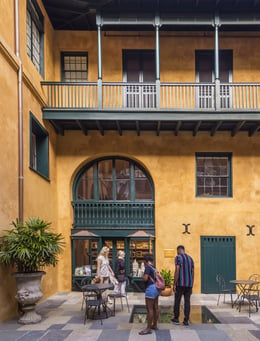
Hotel Monteleone
214 Royal Street
About
Since becoming a state in 1812, Louisiana has participated in America’s bold experiment with democracy. In anticipation of American Democracy: A Great Leap of Faith, a traveling exhibition from the Smithsonian Institution coming to HNOC, our 2023 History Symposium explores how the democratic system has functioned in Louisiana and how key events have influenced our current political environment.

Schedule
Williams Research Center
410 Chartres Street
Daniel Hammer, President and CEO, the Historic New Orleans Collection
Dr. Pearson Cross, moderator, Professor and Director, School of Behavioral and Social Sciences, University of Louisiana at Monroe, and coeditor of The Party is Over: The New Louisiana Politics (LSU Press, 2022)
Dr. Brian Klopotek, Associate Professor of Indigenous, Race, and Ethnic Studies, University of Oregon, in conversation with John Barbry, Director of Development and Programming for the Tunica-Biloxi Language and Cultural Preservation Program
Hotel Monteleone
214 Royal Street
Dr. Steven Procopio, President, Public Affairs Research Council of Louisiana
Dr. Laura Rosanne Adderley, Associate Professor of History, Tulane University
French Quarter
Dr. Theodore R. Foster III, Assistant Professor of African American History and Studies, Benedictine University
Dr. Libby Neidenbach, Interpretive Training Coordinator, the Historic New Orleans Collection
Hotel Monteleone
214 Royal Street
Dr. Albert L. Samuels, Jewel L. Prestage-Kellogg Professor of Political Science and the Chair of the Department of Political Science and Geography, Southern University and A&M College
Rebecca Mowbray, President, CEO, and Samuel Zemurray Chair in Research Leadership, Bureau of Governmental Research, in conversation with Lamar Gardere, Executive Director, the Data Center
Dr. Andy Horowitz, Connecticut State Historian, Associate Professor of History, University of Connecticut
Dr. Pearson Cross
Dr. Pearson Cross and Daniel Hammer
520 Royal Street
Speakers

Dr. Pearson Cross
Dr. Pearson Cross
Dr. Pearson Cross is professor and director of the School of Behavioral and Social Sciences at the University of Louisiana at Monroe, where he teaches courses in Louisiana and American politics. His most recent book is The Party Is Over: The New Louisiana Politics (LSU Press, 2022). He also hosts Bayou to Beltway, a bimonthly radio program on Louisiana politics on Monroe’s NPR affiliate, KEDM.

Dr. Brian Klopotek
Dr. Brian Klopotek
Dr. Brian Klopotek is associate professor of Indigenous, race, and ethnic studies at the University of Oregon. He has authored numerous books and articles on Native American politics and cultures, including Recognition Odysseys: Indigeneity, Race, and Federal Tribal Recognition Policy in Three Louisiana Indian Communities (Duke University Press, 2011). Klopotek was drawn to this topic by his own heritage as a nonfederal Choctaw with Louisiana roots.

John Barbry
John Barbry
John Barbry is director of development and programming for the Tunica-Biloxi Language and Culture Revitalization Program (LCRP). In 1987, Barbry assisted with cataloging of the “Tunica Treasure,” a vast collection of 18th-century Native and European trade and ceremonial goods unearthed at the former village site and cemetery of the Tunica people. In 1993, he became the first Native American to be appointed an archivist at the Smithsonian Institution’s National Museum of the American Indian. Barbry received the 2022 Champion of Culture Award from the Louisiana Endowment for the Humanities.

Dr. Steven Procopio
Dr. Steven Procopio
Dr. Steven Procopio is the president of the Public Affairs Research Council of Louisiana (PAR), where he previously served as policy director, guiding the organization’s research agenda. Prior to joining PAR, Procopio was chief of staff of the Louisiana Division of Administration and served as the director of research and accountability for the Louisiana Office of the Lieutenant Governor and the Department of Culture, Recreation, and Tourism.

Dr. Laura Rosanne Adderley
Dr. Laura Rosanne Adderley
Dr. Laura Rosanne Adderley is associate professor of history at Tulane University. She specializes in the history of the African diaspora, the Atlantic slave trade, Black enslavement in the Americas, and Caribbean history. She is the author of “New Negroes from Africa”: Slave Trade Abolition and Free African Settlement in the Nineteenth-Century Caribbean (Indiana University Press, 2006).

Dr. Theodore R. Foster III
Dr. Theodore R. Foster III
Dr. Theodore R. Foster III is assistant professor of African American history and studies at Benedictine University. He previously taught African American history at the University of Louisiana at Lafayette. Foster’s research, teaching, and writing interests center on how Black freedom narratives of the Civil Rights Movement circulate in popular culture, civil rights tourism, political campaigns, immigrant-justice activism, memorials, and museums.

Dr. Libby Neidenbach
Dr. Libby Neidenbach
Dr. Libby Neidenbach is associate curator at the Historic New Orleans Collection, where she has worked since 2019. She received her undergraduate degree from Tulane University and her MA and PhD in American Studies from the College of William and Mary. She worked as a public historian for the National Park Service in Richmond, Virginia, and New Orleans before joining HNOC. In 2023 she curated “Yet She Is Advancing”: New Orleans Women and the Right to Vote, 1878–1970 and is currently working on an exhibition about Mother St. Croix, an Ursuline nun and photographer. Her scholarship has been published in the Journal of Urban History, Transatlantica, 64 Parishes, and the essay collection Crossings and Encounters: Race, Gender, and Sexuality in the Atlantic World.

Dr. Albert L. Samuels
Dr. Albert L. Samuels
Dr. Albert L. Samuels is the Jewel L. Prestage-Kellogg Professor of Political Science and the chair of the department of political science and geography at Southern University and A&M College. His research interests include American, Black, and Louisiana politics; educational policy; and voting rights. He has written numerous scholarly articles and is a frequent commentator on politics at the local, state, and national levels.

Rebecca Mowbray
Rebecca Mowbray
Rebecca Mowbray is the president, CEO, and Samuel Zemurray Chair in Research Leadership at the Bureau of Governmental Research (BGR). Throughout her career, she has focused on governmental reform, accountability, and transparency. Before joining BGR, she worked as a program evaluator and a journalist. She has master’s degrees in journalism and international relations. Mowbray has also worked in former Czechoslovakia and Indonesia, where she was a Luce Scholar.

Lamar Gardere
Lamar Gardere
Lamar Gardere is the executive director of the Data Center, where he is responsible for guiding the center’s mission of democratizing data into realistic action, ensuring quality standards, and overseeing the ongoing impact of the organization. Gardere previously served as the chief information officer for the City of New Orleans's Office of Information Technology and Innovation. He is nationally recognized for his work implementing and developing the open-data policy for the city.

Dr. Andy Horowitz
Dr. Andy Horowitz
Dr. Andy Horowitz is an associate professor of history at the University of Connecticut and serves as the Connecticut State Historian. A scholar of the modern US, his research focuses on disasters and the questions they raise about race, class, community, trauma, extractive industry, metropolitan development, and environmental change. He is the author of Katrina: A History, 1915–2015 (Harvard University Press, 2020), which won the 2021 Bancroft Prize in American History.
Support
This event is made possible with generous support from our sponsors.


Explore the History Symposium
Since its debut in 1996, HNOC’s History Symposium has become one of Louisiana’s leading public history events. Every year we bring together scholars, experts, and community members to unpack a different topic from our region’s ever-changing narrative.

Related Exhibitions


“Yet She Is Advancing”: New Orleans Women and the Right to Vote, 1878–1970
Related Stories

A Parade of Presidents
HNOC’s holdings shed light on moments when New Orleans welcomed America’s Commander-in-Chief.

Coming to New Orleans, Part I
Introducing a new series tracing the history of immigration to New Orleans
Subscribe to Our Newsletter
