







Inside Angola’s Prison Newspaper, the ‘Angolite’
John Corley, associate editor at Louisiana State Penitentiary, discusses the history and operations of the award-winning periodical.
By John Corley, associate editor of the Angolite
November 21, 2024
By John Corley, associate editor of the Angolite
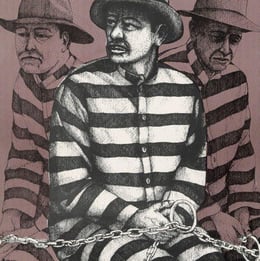
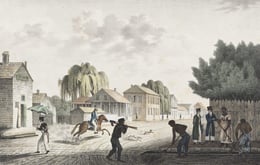
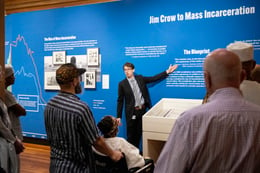
This essay is presented in conjunction with HNOC's 2024–2025 exhibition Captive State: Louisiana and the Making of Mass Incarceration, which investigates the connections between chattel slavery and Louisiana's present-day distinction as the world's incarceration capital. It is on view through February 16, 2025.
 Captive State: Louisiana and the Making of Mass Incarceration
Louisiana’s oldest state publication is produced in the heart of the country’s largest maximum-security correctional facility. With subscribers in every US state and eight overseas countries, the Angolite, the news magazine of the Louisiana State Penitentiary at Angola, is a critically acclaimed, award-winning criminal justice journal, as well as the prison’s official historical record. For nearly 70 years, we have been the voice of the voiceless, cited by outside media for news inside “the fences.”
Over the course of its history, the Angolite has been a seven-time finalist for the prestigious National Magazine Award’s General Excellence prize, the first prison publication to ever be nominated. Our writers and editors have received Robert F. Kennedy and George Polk journalism awards, as well as a Silver Gavel Award from the American Bar Association. We’ve earned several APEX awards for magazine and journal writing and a Thurgood Marshall Journalism Award from the Death Penalty Information Center. Angolite staffers’ work appears in criminal justice textbooks, scholarly journals, and national publications. Some of our editors and reporters have gone on to write books, report for outlets like National Public Radio and ABC-TV, and collaborate on film and radio documentaries.


As Associate Editor, I proudly work to give voice to prisoners whose perspectives on criminal justice issues provide an essential window into the often-shadowy world of incarceration. I am one of the incarcerated journalists who turn out six issues per year. None of our staff had prior journalism experience. One was a farmer, one was a soldier, and I worked on an offshore drilling rig. Each of us, I think, had a knack for talking to people, getting the story, and presenting the story with impartiality—we just didn’t know it. The greatest reward my work offers lies in the countless people I am privileged to meet and speak with. Each enriches my life to no end.
We write the articles, shoot the photographs, and come up with our own ideas for features. (Though we usually have seven employees, a series of recent releases have reduced us to a staff of three, but we work diligently to maintain our usual standard of excellence.) As the associate editor, I am involved in every part of the production process: writing content, doing design and layout, editing, and proofing. When our printed issues arrive from the Office of State Printing in Baton Rouge, we label, bundle, and transport them to the Angola post office for distribution. We’re paid 20 cents an hour, or a maximum of eight dollars a week.

I joined the staff in 2004, after seven years working as an inmate counsel substitute (paralegal), and since then I’ve written nearly 350 criminal justice and human-interest articles and sectionals. I’m proud of all of it, but I am partial to my historical pieces on subjects like medical experiments on prisoners, executions in the old Red Hat cellblock, and the impact of COVID-19. A five-part series tracking the development of the penitentiary’s media outlets—radio, television, and magazine—is the sole history of these important institutions.
My column Legal Spectrum, which provides synopses of current criminal jurisprudence that affects prisoners collectively or individually, is among the most important to our incarcerated readers. (My years as an inmate paralegal certainly help in this regard.) I also cover relevant civil actions, whether death row prisoners challenging execution methods, population challenges to prison health care, or, as recently, farm line workers challenging outdoor labor conditions under the merciless summer sun.
Working from within prison walls has its complications. News resources are drawn from a variety of mainstream outlets, and we rely on the assistance of outside researchers who scour the internet for requested and related information. More importantly, perhaps, our editorial freedom and reporting scope depend very much on political conditions.

As a prisoner-produced publication, the Angolite is subject to administrative oversight, review, and direction, and what that means has varied over time. Founder William Earnest Sadler, a convicted forger and scam artist, was committed to penal-reform advocacy. (His nom de plume, Old Wooden Ear, was a reference to his deafness, a permanent handicap acquired after a beating by an Angola guard.) He used the relative latitude he was given to document Angola’s ever-changing landscape, music, sports, and personal triumphs. The importance of his creative energy became clear after his release in 1956; over the next 20 years, editors struggled to maintain editorial independence and relevance in the face of slashed budgets, administrative indifference, and increasing censorship of our reporting from America’s bloodiest prison.
In 1976, however, Corrections Secretary C. Paul Phelps granted the Angolite license to operate with impunity as long as we conformed to the same ethical and journalistic standards as any other professional publication. Another important development was the 1975 court-ordered desegregation of work assignments, which meant that the Angolite was no longer produced solely by white inmates.

Editors adopted our current magazine format and amplified our spotlight to state and national criminal justice issues such as the death penalty, life without parole, pardon and parole, and prisoners’ rights. Suddenly, bureaucratic corruption, sexual assault behind bars, inhumane living conditions, and the horrors of state-sanctioned electrocution of condemned prisoners were laid bare to the public eye. In the 1990s, though, administrators began to push for “positive programming.” The current administration prefers to limit the influx of research information and be involved in editorial decisions.
Still, our long tradition of advocacy continues, and I am proud to participate in it. My article depicting Angola prisoners whose crimes were committed as juveniles, “Children in the Eyes of the Law,” won a journalism award from the National Council on Crime and Delinquency, an accomplishment of which I am immensely proud. Like other staffers, I have also been honored to write for national news outlets; my story about the penitentiary’s response to the coronavirus ran in the Atlantic in 2023. (I’d met editor Jeffrey Goldberg at the prison rodeo in 2019.) My submission was crafted from media, departmental, and medical reports, a journal I maintained during the period, and from my own experiences of living through it. The Atlantic's assistant editors and fact-checkers were very cordial and patient. It was a pleasure working with them all.


Through it all, the magazine strives to move forward, to present the truth, to educate the public about the redeemable value of human life behind bars. Our work has helped invigorate reformists to push for progressive change and made space for incarcerated people to share their perspectives. I am so proud of what we do.

You can read hundreds of past issues for free through the Reveal Digital and JSTOR collaboration American Prison Newspapers, 1800s-present: Voices from the Inside. Find subscription information here.
Related Books
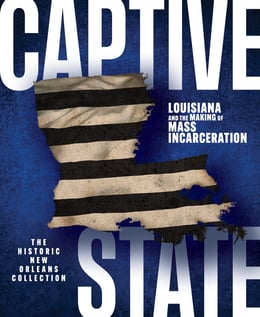
Captive State: Louisiana and the Making of Mass Incarceration
by Eric Seiferth, Katherine Jolliff Dunn, and Kevin T. Harrell (curators) and Nick Weldon (editor)
Related Exhibitions
Captive State: Louisiana and the Making of Mass Incarceration
Learn how the institutions of slavery and mass incarceration are historically linked, and how these connections have made Louisiana the world leader in incarceration today.
Related Stories
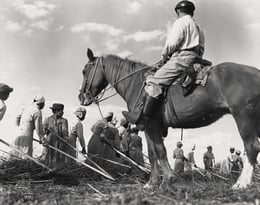
A Long Arc of Injustice
Once the hub of the domestic slave trade, Louisiana now leads the world in incarceration, with Black people disproportionately affected. HNOC’s exhibition Captive State traces the roots of this inequity all the way back to the founding of the state.

Poets Respond to “Captive State” in Verse
Nine Louisiana poets visited the landmark exhibition on the history of incarceration and created original work based on their experiences.
Related Collection Highlights
“Vernon C. Bain” Christening Ceremony Video
When New York City’s war on drugs sent incarceration rates soaring, officials commissioned a floating jail built and christened downriver from New Orleans.
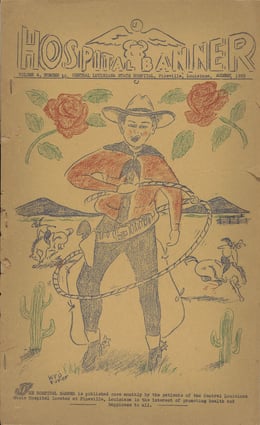
Hospital Banner Newsletters
An unusual periodical, written and produced by residents of the state mental hospital in the mid-20th century
Related News
In NOLA.com Guest Column, HNOC Historian Discusses “Captive State” As Public History Project

HNOC Book “Captive State” Receives Southeastern Museum Conference Publication Award

HNOC Announces Extension of Exhibition Examining Incarceration in Louisiana
New Orleans Stories,
Delivered to Your Inbox
