








Common Routes
St. Domingue • Louisiana
Stories of the thousands of émigrés who settled in Louisiana in the wake of the Haitian Revolution

Common Routes: St. Domingue • Louisiana
HNOC with Somogy Éditions d’Art 2006
hardcover • 9½" × 11" • 128 pp.
72 color images; 12 b&w
ISBN 978-2-85056-966-1
Currently out of print
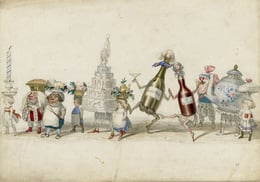
From the earliest European contact through the present day, Saint Domingue (now Haiti) and Louisiana have been bound together by linked economies, cultural enterprises, and peoples. Common Routes was published in conjunction with a groundbreaking exhibition that illuminated this shared history. Complete with full-color reproductions of images and artifacts from the exhibition, and featuring essays by noted scholars, this volume offers stories of individuals rooted in the intersection of cultures and rerouted across oceans in search of fortune or freedom. Among the protagonists are the thousands of émigrés who settled in Louisiana in the wake of the Haitian Revolution. Their civic and artistic contributions imbued New Orleans with the unique cultural dye that marks the city’s character to this day.
Related Stories

How “Bloody” was O’Reilly?
Earlier historians called Alejandro O’Reilly an “executioner” because of his role in quelling the 1768 rebellion against Spanish rule. HNOC reevaluates the infamous governor’s legacy.

How the Fires of 1788 and 1794 Changed New Orleans
Two great fires destroyed large portions of New Orleans during the city’s Spanish colonial era, spurring changes that can still be seen today.
Related Collection Highlights

Bernardo de Gálvez Patent of Nobility
This beautiful document from a grateful king extols Gálvez’s virtues as a soldier and as a man.

Historic Maps from “Cartographic Legacies”
Maps are more than visual representations of landscapes and geographic features; they’re also storytellers.
Related Books

Spanish New Orleans and the Caribbean / La Nueva Orleans y el Caribe españoles
edited by Alfred E. Lemmon

Creole World: Photographs of New Orleans and the Latin Caribbean Sphere
by Richard Sexton
with essays by Jay D. Edwards and John H. Lawrence

Charting Louisiana: Five Hundred Years of Maps
edited by Alfred E. Lemmon, John T. Magill, and Jason Wiese; consulting editor, John R. Hébert
Subscribe to Our Newsletter
