








“A New Door for My People”
Black Life in Reconstruction-Era Louisiana
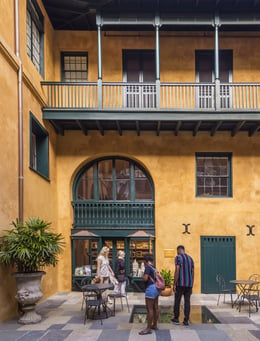
REACH Center of the New Orleans Public Library
2022 St. Bernard Avenue
Corpus Christi Church Complex, Building C
3rd Floor Community Coworking Space
Admission is free with registration required. This event is sold out (details below).
This event has sold out. Ticket holders should plan to arrive at the venue no later than 8:45 a.m. At 8:50 a.m., all unclaimed tickets will be released and made available to the public on a first-come, first-served basis.
Join the Historic New Orleans Collection and the REACH Center of the New Orleans Public Library for “A New Door for My People,” a half-day public program exploring Black life in Reconstruction-era Louisiana. Moderated by Mark Roudané, whose great-great-grandfather co-founded the radical newspaper the New Orleans Tribune, the program will feature scholars Justene Hill Edwards (University of Virginia) on the Freedman’s Bank, Tera Hunter (Princeton University) on family reunification, and William D. Jones (Sam Houston State University) on the Freedman’s Bureau and Home Colonies.


Four years after the United States nearly tore itself apart in the Civil War, more than 330,000 African American men, women, and children living in Louisiana transitioned from slavery to freedom. The next 12 years—a time known as Reconstruction, from 1865 to 1877—were filled with hope, hard work, and hardship as newly freed men and women sought new possibilities. Hettie Pierce, who had been enslaved in north Louisiana, described the era as a time of “big excitement. I knew that at last the good Lord had opened a new door for my people.”

Reconstruction was a dynamic age when African American citizenship became an active reality rather than a deferred ideal. African American men, armed with suffrage and newly elected to public office, helped draft and pass one of America’s most progressive Constitutions, which guaranteed equal access to public education and accommodations and broadened the privileges of citizenship for all. New doors also opened outside the statehouse—in towns, villages, and cities across Louisiana, as freedmen and women forged community; reunited with family separated during enslavement; established churches, schools, and fraternal organizations; and began saving for the future.
Limited free parking is available on site. Additional free street parking is available surrounding the REACH center.
Speakers

Justene Hill Edwards
Justene Hill Edwards
Justene Hill Edwards is an associate professor of history at the University of Virginia. An Andrew Carnegie Fellow and Mellon New Directions Fellow, she is the author of Savings and Trust: The Rise and Betrayal of the Freedman’s Bank (W.W. Norton. 2024), a comprehensive account of the Freedman’s Savings and Trust Company and its depositors. Always highlighting the lives of enslaved and formerly enslaved people, Edwards studies the relationship between economic and political freedom for people of African descent in the United States.

Tera W. Hunter
Tera W. Hunter
Tera W. Hunter is Edwards Professor of American History and chair of the African American Studies Department at Princeton University. Hunter is the recipient of numerous fellowships and is the author of the award-winning To Joy My Freedom: Southern Black Women’s Lives and Labors after the Civil War (Harvard University Press, 1997) and Bound in Wedlock: Slave and Free Black Marriage in the Nineteenth Century (Harvard University Press, 2017).

William Jones
William Jones
William Jones is a lecturer in the department of history at Sam Houston State University who earned his PhD from Rice University in 2020. His current book project focuses on survivors of the domestic slave trade to the lower Mississippi River valley. A 2022 recipient of HNOC’s Dianne Woest Fellowship in the Arts and Humanities, Jones’s work on slavery and Reconstruction has been featured in 64 Parishes and Louisiana History.

Mark Roudané
Mark Roudané
Mark Roudané is the great-great-grandson of Dr. Louis Charles Roudanez, founder of the South’s first Black newspaper, L’Union, as well as the New Orleans Tribune, America’s first Black daily. The author of The New Orleans Tribune: An Introduction to America’s First Black Daily Newspaper, Roudané’s writing has appeared in the Atlantic and 64 Parishes. Through his writings and collaborative public history initiatives, Roudané has helped foster greater understanding of and appreciation for the Black freedom movement born in New Orleans over 160 years ago.
Follow his work at www.facebook.com/roudanezhistory and www.roudanez.com.
Support
This program is presented by HNOC in collaboration with New Orleans Public Library (NOPL) and the library's REACH Center.

Related Stories

“Lost Friends” Ads Reveal the Heartbreak of Family Separation During Slavery
Messages from the past dispel the benevolent slaveholder myth.

In 1860s New Orleans, Black Activists Fought and Died for the Right to Vote
Nearly a century before the passage of the Voting Rights Act, Reconstruction-era actvisits won—then lost—Black male suffrage.
Related Collection Highlights

“The Scourged Back”
HNOC acquired an original copy of the infamous image that took Civil War-era America by storm, quickly becoming a tool of the abolitionist cause.

Dr. Louis Charles Roudanez Papers
A rare collection of manuscript essays and family correspondence offers a thrilling look at one of the most influential people in the early struggle for African American civil rights in Louisiana.
Related Books
Monumental: Oscar Dunn and His Radical Fight in Reconstruction Louisiana
by Brian K. Mitchell, Barrington S. Edwards, and Nick Weldon

Subscribe to Our Newsletter
