








Williams Research Center and WRC Annex
Two-story Beaux Arts structure, built 1915
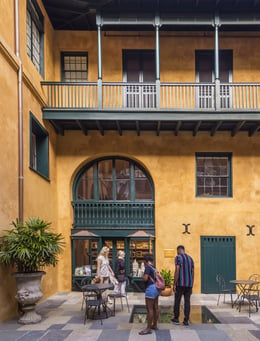
The Collection’s holdings are made available to the general public in the Williams Research Center (WRC), which includes a second-story reading room, staff offices, and collections storage. In 2007 HNOC built an addition to the WRC on an adjoining lot at the corner of Conti and Chartres Streets. It was the first new construction completed in the French Quarter after Hurricane Katrina.
Williams Research Center
Built in 1915 in the Beaux Arts style, the two-story brick structure housing the WRC is the work of architect Edgar A. Christy and builder James A. Petty. It was erected to house the Second City Criminal Court and the Third Precinct Police Station. The Chartres Street building, purchased by the State of Louisiana in 1957, had been vacant for many years when HNOC bought the property in 1993. The WRC opened to the public in 1996.


During the colonial period, the land was owned by the Marigny de Mandeville family and, through the years, by other well-known Louisiana families—Delachaise, Forstall, Macarty, Destrehan, and Perrilliat. The present lot, once part of a larger property extending to the corner of Chartres and Conti Streets, was part of the succession of Celeste Robin de Longy, widow of Jean Noel Destrehan, in 1825. A long, low structure—described as a maison à étage—with a separate kitchen at the back of the property was demolished before the construction of the present-day building.
WRC annex
Completed in June 2007, HNOC’s annex to the Williams Research Center was the first new construction in the French Quarter to be done after Hurricane Katrina. The addition provided HNOC with a lecture hall, named the Boyd Cruise Room, as well as three floors of archival storage.


New Orleans architect Davis Jahncke based his design for the addition on a drawing obtained from the New Orleans Notarial Archive. The illustration depicts a hotel, complete with a blush-hued facade, that stood on the exact lot in the 1850s.
In addition to following the design, Jahncke also implemented several 19th-century building techniques, such as hand-hammered hardware and a false carriageway and chimneys.
Williams Research Center
Explore centuries of Gulf South culture with unparalleled access to rare documents, art, and historic treasures.

 Hours & Location
410 Chartres Street
Tuesday–Saturday, 9:30 a.m.–4:30 p.m.
Closed Sunday and Monday

 Admission
Free and open to the public.
Appointments are recommended but not required.
 Contact Us
To make an appointment or to correspond with a reference associate about your research topic, email reference@hnoc.org or call (504) 598-7171.
Our Buildings
HNOC’s Architectural Treasures
Every building has stories to tell. Learn more about HNOC’s historic French Quarter properties.


Related Stories

The Story Behind Some of TV’s Most Haunting Ruins
Before appearing in HBO’s “True Detective” and Beyoncé's “Lemonade,” Fort Macomb provided a crucial line of defense for New Orleans and the country at large.

The Woman behind New Orleans’s Famous Pontalba Buildings
The Baroness de Pontalba survived gunshot wounds and left her husband in France before constructing two of New Orleans's most iconic structures.
Related Collection Highlights


Mother St. Croix Photographs of Ursuline Convent
The ebullient nun documented her cloisters, sisters, and pupils with care and skill. In doing so she became the earliest known woman to photographically record daily life in New Orleans

Clarence John Laughlin Archive
Through his dreamlike black-and-white images, the surrealist Louisiana photographer explored, amplified, and commented on the mystique of the South.
Related presentations
Vieux Carré Survey Case Study

Related Books


Creole World: Photographs of New Orleans and the Latin Caribbean Sphere
by Richard Sexton
with essays by Jay D. Edwards and John H. Lawrence

Guidebooks to Sin: The Blue Books of Storyville, New Orleans
by Pamela D. Arceneaux
with a foreword by Emily Epstein Landau
Related News

NOLA.com: Former K-Paul’s Louisiana Kitchen Gets a New Life and a New Name

HNOC Names Former K-Paul’s Restaurant Building in Honor of Chef Paul Prudhomme

Subscribe to Our Newsletter
