

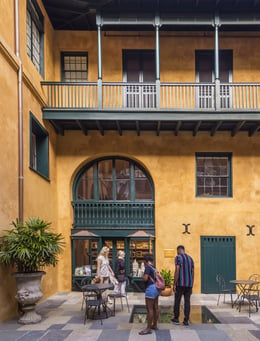







Guillot House
Creole townhouse with side carriageway, built 1805–10
This brick Creole townhouse has been used as a rental property, apartment building, boardinghouse, furniture store, garage, and offices. Most notably, it housed Tennessee Williams’s first apartment—a garret space located in the attic of the two-story building.
Timeline
1790s: A small cottage is built on the property, owned by Spanish colonist Luis Adam.
1805–10: Joseph Guillot and Claude Gurlie, prominent architect-builders in New Orleans, construct the current two-story house, doubling the value of the property.

1852: A plan of the property by Charles de Armas (seen in this 1955 watercolor copy by Boyd Cruise) documents the site, showing outbuildings. Throughout the 19th century, the house is divided into several apartments.
1892: Caroline Levy purchases the property and moves her secondhand furniture store into the ground floor. The Levy furniture store continues to grow into the early 20th century, filling a warehouse across the rear courtyard that is linked to their new storefront on Royal Street.
1922: John Benino purchases the century-old property and moves a still into the old furniture warehouse to make bootleg liquor. Prohibition agents raid the property in April 1923 and dispose of 1,000 gallons of wine by pouring it down Toulouse Street. This marks the first of nearly a dozen times the property is raided during Prohibition.

1938: Recently arrived in New Orleans, playwright Tennessee Williams rents a garret apartment in the building. He later sets his play Vieux Carré in the house, describing it as “a poetic evocation of all the cheap rooming houses of the world.”
1945: Kemper and Leila Williams purchase the property in preparation for their move into the residence next door. They turn the ground floor into a garage and laundry room. Five years later they tear down the last of the old outbuildings, making a private side courtyard.
1977: HNOC restores the building in the late 1970s to match the 1852 drawing of the building. It houses staff offices until HNOC closes the 533 Royal Street complex for renovations in 2023.
Williams Residence
Currently closed for repairs, the historic townhouse offers a window into the day-to-day life of HNOC’s founders in midcentury New Orleans.

Our Buildings
HNOC’s Architectural Treasures
Every building has stories to tell. Learn more about HNOC’s historic French Quarter properties.


Related Stories

The Woman behind New Orleans’s Famous Pontalba Buildings
The Baroness de Pontalba survived gunshot wounds and left her husband in France before constructing two of New Orleans's most iconic structures.

Masonic and Odd Fellows Buildings in New Orleans
Society halls and temples have had a lasting impact on the local architectural landscape. Here’s where to find them.
Related Collection Highlights

Mother St. Croix Photographs of Ursuline Convent
The ebullient nun documented her cloisters, sisters, and pupils with care and skill. In doing so she became the earliest known woman to photographically record daily life in New Orleans


Clarence John Laughlin Archive
Through his dreamlike black-and-white images, the surrealist Louisiana photographer explored, amplified, and commented on the mystique of the South.
Related presentations
Vieux Carré Survey Case Study

Related Books


Guidebooks to Sin: The Blue Books of Storyville, New Orleans
by Pamela D. Arceneaux
with a foreword by Emily Epstein Landau

Haunter of Ruins: The Photography of Clarence John Laughlin
with essays by Jon Kukla, John H. Lawrence, Andrei Codrescu, Ellen Gilchrist, Shirley Ann Grau, Jonathan Williams, Albert Belisle Davis, and John Wood
Related News


NOLA.com: This Former French Quarter Restaurant Will Now Tell New Orleans History After $6.4M Renovation

NOLA.com: Former K-Paul’s Louisiana Kitchen Gets a New Life and a New Name
Subscribe to Our Newsletter
