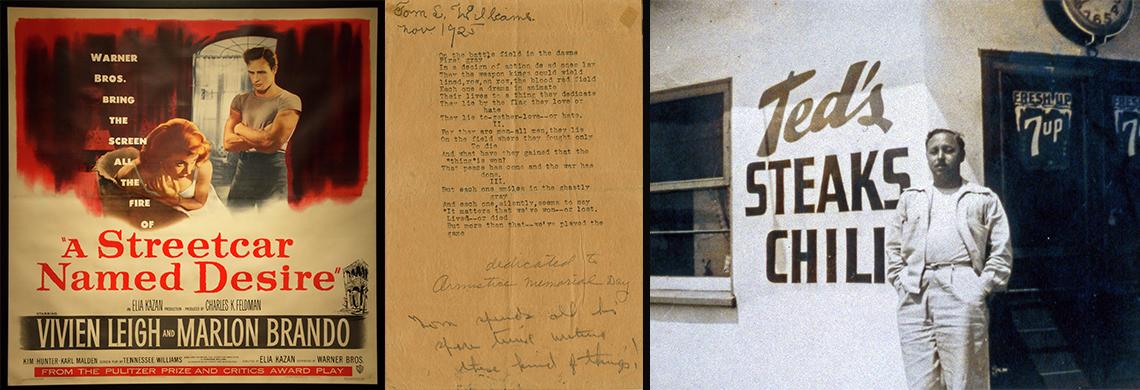
The largest private holding of Tennessee Williams materials was acquired by The Collection in 2001 making it available to researchers and Williams enthusiasts

glass menagerieTennessee Williams was an inveterate world traveler, and a list of his regular ports of call reads like the itinerary for an overly ambitious group tour.  Sojourns in Rome, Tangier, Tokyo, Key West, London, Bangkok, Acapulco, and other destinations provided him a place to work, a change of scenery, and perhaps a temporary escape from his “blue devils,” the recurring anxiety episodes he never seemed able to elude.  But one place always drew him back.  “Each time I have felt some rather profound wound, or a loss or a failure,” Williams wrote, “I have always returned to this city.  At such periods I would seem to belong there and no place else in the country.”  The city, of course, is New Orleans, and he found the restorative ambiance of the Vieux Carré so pacifying that he once said he wanted to die in the big brass bed of his Dumaine Street home.  Unfortunately, his 1983 death came not peacefully on Dumaine (he had actually sold the property shortly before dying) but under somewhat suspicious circumstances in another bed, at the Hotel Elysée in Manhattan.

Although Williams had wanted his body cremated and his ashes strewn into the Caribbean waters close to where his poet-idol Hart Crane intentionally drowned, more practical considerations forced Williams’s burial in St. Louis—the city he hated.  Yet his presence continues to be felt in the Vieux Carré, and there have even been some suggestions recently about disinterring the body and relocating his remains to New Orleans.  If spirits hover near their bones, one does get the idea that Tennessee’s would prefer the Elysian Fields of New Orleans to the Gateway Arch of St. Louis.  But until this metaphysical repatriation takes place, Williams enthusiasts and scholars will be pleased to know that a significant part of his legacy has already been relocated to his beloved Vieux Carré—at the Historic New Orleans Collection.

In early 2001, after long and deliberate negotiations, THNOC successfully completed the acquisition of the largest private collection of Tennessee Williams materials anywhere in the world.  The collection, which was carefully packed by THNOC staff in 66 boxes and transported from San Antonio, Texas, is the fruit of a lifelong labor of love for collector Fred Todd.  Born in 1936, Mr. Todd grew up in a bookish home and eventually earned his master of library science degree from the University of Texas at Austin.  Mr. Todd says that initially he had no interest in becoming a serious collector but rather “simply enjoyed reading and added books out of interest.”  But all that changed in 1956 when he saw Tennessee Williams’s screenplay Baby Doll.  Although Baby Doll is treasured by students of author Tennessee Williams and director Elia Kazan, most moviegoers who saw its release were either bemused or disgusted by it.  Some who never actually saw the movie, such as Cardinal Spellman who denounced it from his pulpit, and Joseph Kennedy Sr., who refused to show it in his string of movie houses, objected to the film for its depiction of a child bride who refuses to have her marriage consummated.  On the other hand, Mr. Todd said that he was “totally overwhelmed” when he saw the film as a sophomore in college, and his impressionable experience led him to purchase his first collectable—a paperback edition of Baby Doll.

During Mr. Todd’s stint in the army he kept buying items and having them shipped to him in Alaska, where he was stationed.  About this time he realized that each individual purchase was invariably leading to another, so that his collecting became something of a fixation.  As he admits, “I was never satisfied to own the basic items.  I wanted everything I could get my hands on.”  His used-bookstore browsing soon evolved into a more systematic method of accumulating Williams materials, including frequent networking with specialty dealers.  The collector’s firm insistence on acquiring mint-condition items led him to trade several variations of a work in order to find the one suited to his exacting standards.  He soon found it necessary to liquidate his other collectables in order to concentrate on Williams.

Although Mr. Todd regards the rewrites for The Glass Menagerie and A Streetcar Named Desire as the “highlights” of his collection, this acquisition has something of interest for everyone from the Williams scholar, who might be studying the developmental variants of playscripts, to fans of Vivien Leigh, who will be delighted by perusing her personal photo scrapbook from the filming of A Streetcar Named Desire.  Indeed, the serious but eclectic and sometimes quirky range of Mr. Todd’s interests is what forms the personality of the collection.  Trying to list the materials in this limited space only does an injustice to the scope of the collection, but a brief description conveys Mr. Todd’s concern with diversification. There are numerous printed items in the collection, supplemented by unpublished manuscripts as well as theatre and cinema materials.   In addition to the many typescripts and manuscripts of works such as Streetcar and Menagerie, there are dozens of playbills, as well as signed first editions of Williams’s plays and other works, unpublished letters, myriad books about Williams, translations of his work, film scripts, and photos of Williams with friends and associates.

Delving beyond these archival staples, one finds such remarkable treasures as the notes on the filming of The Rose Tattoo, an operatic version of Summer and Smoke, an outrageous playscript for a western—complete with characters named “Smitty” and “Slim,” a touching prose-poem to lover Frank Merlo entitled “The Final Day of Your Life,” and numerous promotional materials and memorabilia from Baby Doll, including the film script with agitated notes from director Elia Kazan to screenwriter Tennessee Williams (“What is the conclusion?  What happens to Baby Doll tomorrow?”).   Among the more curious parts of the collection are an unrealized Williams-Kazan film script called The Twister, a short story written by Williams’s mother Edwina when she was eight years old, and some of Williams’s own financial records.

A noted Williams scholar estimates that the Todd materials constitute “the most important collection of such materials [once held] in private hands,” and Dr. George Crandell, Williams’s most accomplished bibliographer, notes, “For completeness and depth of coverage Mr. Todd’s collection rivals that of the best institutional holdings.”  And so The Historic New Orleans Collection now takes its place alongside Harvard, Columbia University, The University of Texas at Austin, and UCLA as one of the major repositories for Tennessee Williams materials in the world.  Although a number of collectors and institutions pursued the materials, Mr. Todd says that his encounters with the staff and the facilities were what convinced him that THNOC would be the best home for his beloved collection.  “And last, but not least,” Mr. Todd observes, “how could one overlook the association between Tennessee Williams and New Orleans—what better place could these materials go?  It’s not like sending them to Nebraska.”  Welcome home, Tennessee.

—Robert Bray
Dr. Robert Bray is founding editor of The Tennessee Williams Annual Review (co-produced by The Collection, visit the publications page for more information) and  professor of English at Middle Tennessee State University.